The Arctic is one of the harshest environments on Earth. Extreme cold, strong winds, long winters, and limited food make survival difficult for wildlife. Yet many animals have developed remarkable adaptations that help them live in these conditions. One of the most impressive examples is the musk ox.
Musk oxen have lived in Arctic regions for thousands of years. Their thick coats, powerful bodies, and social behavior help them survive in places where few large mammals can. One of their most fascinating behaviors is forming protective circles when predators, such as wolves, come near.
Researchers studying why musk oxen form protective circles explain that this defensive strategy greatly improves the herd’s chances of survival. Instead of running away as individuals, musk oxen work together to protect vulnerable members and create a strong barrier against predators.
Life in the Arctic Requires Teamwork
Musk oxen live in herds for much of the year.
Wildlife researchers explain that group living provides important advantages in Arctic environments. Herd members benefit from shared awareness, better predator detection, and stronger protection for young animals.
Unlike solitary species that must depend only on their own survival skills, musk oxen rely heavily on cooperation.
This social structure is the foundation of their defensive behavior.
Predators Remain a Constant Threat
Although adult musk oxen are large and powerful, predators still pose a serious threat.
Arctic wolves are among the most important dangers, especially for calves and younger animals.
Researchers explain that wolves often hunt in groups, using teamwork to target vulnerable members of a herd.
Because wolves cooperate while hunting, musk oxen have developed a cooperative defense of their own.
The result is one of the most effective group defense strategies in the animal kingdom.
The Defensive Circle Protects Young Animals
When danger approaches, musk oxen often gather into a tight formation.
Adults move to the outside, while calves stay toward the center.
Researchers explain that this arrangement protects the youngest and most vulnerable herd members from attack.
The formation allows calves to remain shielded while the adults face the threat.
This strategy can greatly improve calf survival rates.
Powerful Horns Create a Defensive Barrier
Musk oxen have strong, curved horns that play an important role in defense.
When they form a circle, adults usually face outward toward approaching predators.
Wildlife experts explain that this creates a wall of horns around the herd.
Any predator that tries to get close must face several defensive animals at once.
This makes an attack far more dangerous and difficult.
Standing Ground Can Be More Effective Than Running
Many prey animals try to survive by running away.
Musk oxen often use a different strategy.
Researchers explain that deep snow, rough terrain, and the presence of young calves can make fast escape difficult.
Instead of scattering, staying together allows the herd to use its combined strength.
For musk oxen, cooperation is often a better survival strategy than flight.
Communication Helps Coordinate the Herd
Strong group defense depends on coordination.
Scientists studying musk ox behavior believe that body language, movement patterns, and vocal signals help organize defensive formations.
Herd members respond quickly when danger is detected.
This fast coordination helps make sure vulnerable animals are protected.
The ability to act as one group increases the herd’s overall chance of survival.
Thick Fur Supports Arctic Survival
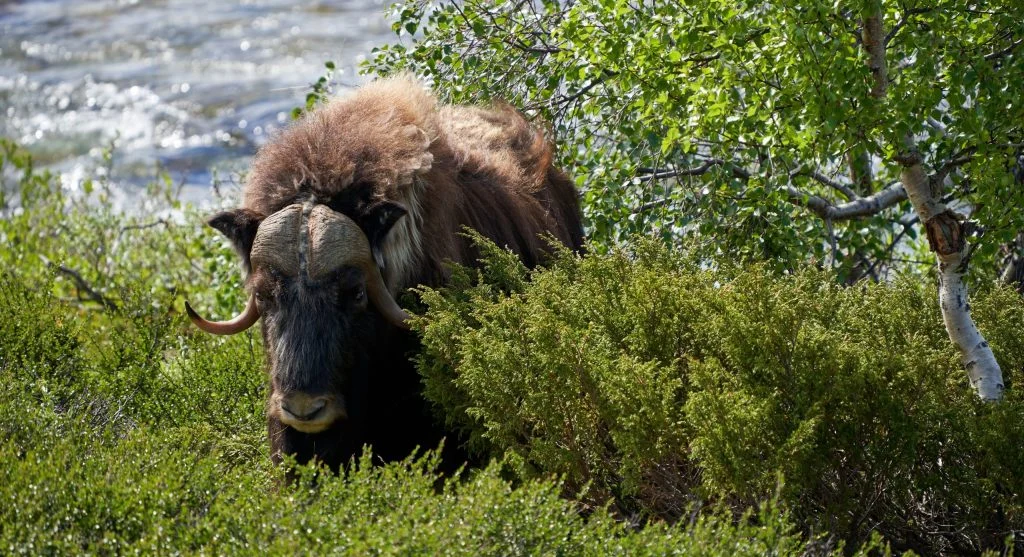
Along with their social behavior, musk oxen also have impressive physical adaptations.
Their dense coats contain one of the warmest natural fibers found in mammals.
Researchers explain that this insulation helps musk oxen survive temperatures far below freezing.
Living through Arctic winters requires both physical strength and smart behavior.
Together, these adaptations have helped musk oxen survive for thousands of years.
Calves Learn by Observing Adults
Young musk oxen spend a lot of time watching older herd members.
Wildlife experts explain that calves gradually learn how to respond to predators and move through difficult environments.
Growing up inside a protective herd gives them important chances to learn.
These lessons help prepare them for survival as adults.
Arctic Ecosystems Depend on Balance
Musk oxen play an important role in Arctic ecosystems.
As large herbivores, they affect plant communities and also provide food for predators.
Researchers explain that healthy predator-prey relationships help maintain ecological balance.
Understanding these connections supports better conservation planning.
Protecting Arctic biodiversity benefits entire ecosystems.
Conservation Efforts Support Wildlife Populations
Scientists continue to monitor musk ox populations across Arctic regions.
Research helps identify challenges linked to habitat conditions, climate patterns, and ecosystem changes.
Conservation programs focus on supporting healthy wildlife populations and protecting important habitats.
The survival of Arctic species often depends on careful ecosystem management.
Frequently Asked Questions
Q: Why do musk oxen form protective circles?
A: The formation helps protect calves and vulnerable herd members from predators.
Q: What predators hunt musk oxen?
A: Arctic wolves are among the primary predators of musk oxen.
Q: Why don’t musk oxen simply run away?
A: Standing together often provides better protection than scattering across difficult Arctic terrain.
Q: How do musk oxen defend themselves?
A: They use powerful horns, group formations, and cooperative behavior.
Q: Where do musk oxen live?
A: Musk oxen inhabit Arctic tundra regions in North America and Greenland.
Key Takeaway
Musk oxen form protective circles because cooperation greatly improves survival in the Arctic. By surrounding calves with strong adults and outward-facing horns, these animals create an effective defense against predators. Their behavior shows how teamwork can become one of nature’s most powerful survival tools.